

Written by Eilidh Stewart-Barritt, Neurodiversity Workplace Coach, DSE Assessor and Chief Operating Officer of Inspired Ergonomics.
As a busy professional with ADHD and Dyslexia, I use AI to help me carry out work that would otherwise take additional hours, if not days or weeks, of extra time and mental capacity. In our business, we use AI to help us operate and provide services that we would otherwise be years away from offering. In the industry I work in, AI is being used to reduce the reliance on expensive human professionals for specialist services, while improving the accuracy, reliability and affordability of Health and Safety recommendations and guidance. Fab. It’s a whole new world.
However, I cannot help but be reminded of another rapidly adopted technological advancement that was once touted as the saviour to a human behavioural problem: vaping. At one point, the NHS was actively encouraging smokers to switch to vaping, as part of a healthier lifestyle or a cessation plan. Sales of fruity flavoured vapes grew year on year in a trajectory not unlike the adoption of AI. Stratospheric. High street bins, surrounded by the discarded carcases of vapes in every shape and size, remind me of my old school homework folder: covered in tacky, brightly coloured, fruity smelling stickers, designed to distract me from doing anything resembling actual work. Now, the science is catching up, and it is looking like vaping was not quite the good idea it was sold as. Similar to the rate of adoption, is the rise of health-related concerns attributed to both technologies…humans seem to have a collective habit of jumping first, asking questions later.
I have had a sneaking suspicion for a while that the way my clients, and I, use AI may not be the panacea it promises to be, and that where we have patched one hole, a leak has sprung up elsewhere. This is my attempt to look objectively at the human impact of using AI in the workplace, through the lens of biopsychosocial ergonomics.
Here is a smaller, more everyday version of the suspicion I mentioned above. We have all read and rolled our eyes at those emails that ping into our inboxes, written as though they were constructed and delivered by a professor of English demonstrating technical supremacy in the language. It is one of the more obvious tells that a person has handed a task over to AI wholesale, rather than using it to sharpen their own thinking or polish their own work, and it is worth keeping in mind as we journey through my findings, because it turns out to be a genuinely useful everyday signal of some of the impacts of Ai usage, not just a source of sanctimony.
IS AI CHANGING THE WAY WE THINK?
Cognitive skills respond, in a fairly straightforward way, to how often they are used. A skill exercised regularly tends to stay sharp. A skill consistently handed over to another system, whether a calculator, a satnav, or now an AI assistant, tends to fade through simple lack of practice. This is not a new phenomenon, and it is not, in itself, a criticism of AI. Very few of us still commit telephone numbers to memory, and few would consider that a meaningful loss.
The relevant question for the workplace is not whether AI affects cognition, since the evidence set out below is clear that it does, but rather which cognitive skills are worth deliberately preserving, and which can reasonably be delegated. That is a decision each organisation, and each individual, is entitled to make consciously rather than by default or trend.
What the research shows
A 2025 study by researcher Michael Gerlich, published in the journal Societies, surveyed and tested 666 participants in the UK across three age groups using a standardised measure called the Halpern Critical Thinking Assessment. It found a clear association between frequent, unstructured use of AI and lower scores on standardised critical thinking assessments, mediated by cognitive offloading. Younger, heavier users showed the steepest decline, while higher educational attainment appeared to buffer the effect. A subsequent study by the same researcher, again using structured writing tasks, found that deliberate, structured use, in which participants were prompted to question and reflect rather than simply accept AI output, did not produce the same decline. In some cases, performance improved.
A small scale neuroimaging study at MIT found reduced activity in brain regions associated with memory and attention among participants who used AI assistance to write essays, compared with those who wrote unaided.
A large scale study of customer support staff, carried out by economists at MIT and Stanford (Brynjolfsson, Li and Raymond, published in the Quarterly Journal of Economics), recorded average productivity gains of approximately fifteen per cent following the introduction of an AI assistant. The greatest gains were seen among newer and less experienced staff, who came more quickly to perform comparably to colleagues with considerably more experience.
Taken together, the evidence indicates that AI does not have a single, uniform effect on cognition. It can improve performance in the short term while gradually reducing unaided proficiency in the same task, and both can be true of the same person at the same time.
AI, EXECUTIVE FUNCTION AND MEMORY
Executive function is the set of mental skills that allow us to plan, hold information in mind, switch between tasks, and resist an easier but less useful response in favour of a better one. It is a reasonable and important question to ask whether AI affects this system specifically, rather than critical thinking in general terms.
Direct, long-term research on AI and executive function is still limited, simply because these tools have not been in widespread use for long. What does exist draws heavily on a longer established body of research into digital technology more broadly. A comprehensive review of that literature found that heavy media multitasking and habitual reliance on digital devices is consistently associated with reduced inhibitory control, weaker working memory and poorer everyday self-regulation, with effects more pronounced in how people describe their own difficulties than in laboratory performance tests. There is a reason why some of us still prefer pen and paper to never ending app usage, digital planners and word processing.
For me, in practice, this often surfaces as small, telling admissions in a coaching conversation: forgetting a colleague’s name five minutes after being introduced, rereading the same email three times before it feels safe to send, or realising halfway through a meeting that a decision was made and nobody can quite remember who made it or who is actioning. It is the mental equivalent of a gym membership you stopped using eighteen months ago. The equipment is all still there. It just doesn’t do much for you if you never turn up. Guilty as charged.
Early research focused specifically on generative AI points in a similar direction. A 2026 review by Noorbehbahani and Oyibo, published in Computers in Human Behavior Reports, set out to address a specific gap: research on AI overdependence had grown quickly but remained scattered across education, professional work and healthcare, with no single review pulling the evidence together. Their review noted evidence of reduced information retention among people who habitually use AI to generate answers rather than recall information themselves, a pattern some researchers have termed digital amnesia. The mechanism proposed is straightforward: memory and executive function both depend on active retrieval and intentional effortful processing, consistently outsourcing that effort appears to weaken it over time, in the same way an unused skill weakens in any other context. I found this oddly comforting. It might not be ADHD or perimenopause after all, or at least, not only that.
The honest summary is that the underlying mechanism is well understood and reasonably well evidenced in the broader digital technology literature, while AI specific, long-term evidence is still emerging. This is a sensible area for continued caution rather than alarm, and a strong case for the structured, reflective use of AI discussed throughout this guide, rather than passive delegation and overreliance.
DOES A FASTER PACE OF WORK DAMAGE OUR ABILITY TO FOCUS
This question comes up often in my practice. It is what prompted me to research this article in the first place, and it is responsible for many hours of coaching discussions. From my reading, I quickly realised it deserves a considered answer rather than a simple yes or no.
There is well established research predating AI entirely, such as the work of Gloria Mark at the University of California, whose studies found it can take over twenty minutes to fully return to a task after an interruption or distraction. This shows that frequent switching between tasks measurably reduces the depth and quality of attention. In neurodivergent people, interruption is known to have an even greater detrimental impact. If AI increases the volume and pace of tasks a person handles in a day, without also changing how that work is structured, the risk of this kind of fragmented attention increases exponentially, even where each individual task is completed faster. In practice, this might look like finishing a rapid, AI assisted first draft in ten minutes, only to spend the rest of the morning skimming, re-reading and half starting three other tasks without properly settling into any of them.
There is also more direct, if indirect, supporting evidence. Large scale European research, conducted by EU OSHA using data from more than 27,000 workers across the EU, found that AI use associated with increased time pressure and work overload was linked to a fifty per cent higher likelihood of reported stress, anxiety or depression. For ergonomists, this is significant. Sustained stress and time pressure are well documented causes of reduced attentional capacity and reduced performance, so while no study has yet tracked the same workers’ sustained attention over several years of AI assisted work, the mechanism connecting pace, pressure and attention is a credible and well supported one. It is also one we can design for, in terms of work systems and organisational culture.
What can be said with confidence is this: the risk is not inherent to AI itself, but to an increase in pace that is not matched by adequate recovery time, task structure or workload control, the elements that sit firmly under organisational control. Under human leadership control. This is precisely the kind of risk that existing UK health and safety obligations, discussed below, are designed to tackle.
SIGNS FOR MANAGERS AND LEADERS TO LOOK OUT FOR
There is not yet a single validated tool for judging whether a team is using AI too much or too little….but there will be signs. To coin a popular meme, “Tell me you’re using Ai too much, without telling me you’re using Ai too much.” There are observable indicators worth watching for, drawn from the patterns described above.
The overly polished, robotic email mentioned at the start of this article is a useful case in point. It is often the first outward sign of the pattern in the list below, work whose reasoning the person producing it can no longer fully explain or defend.
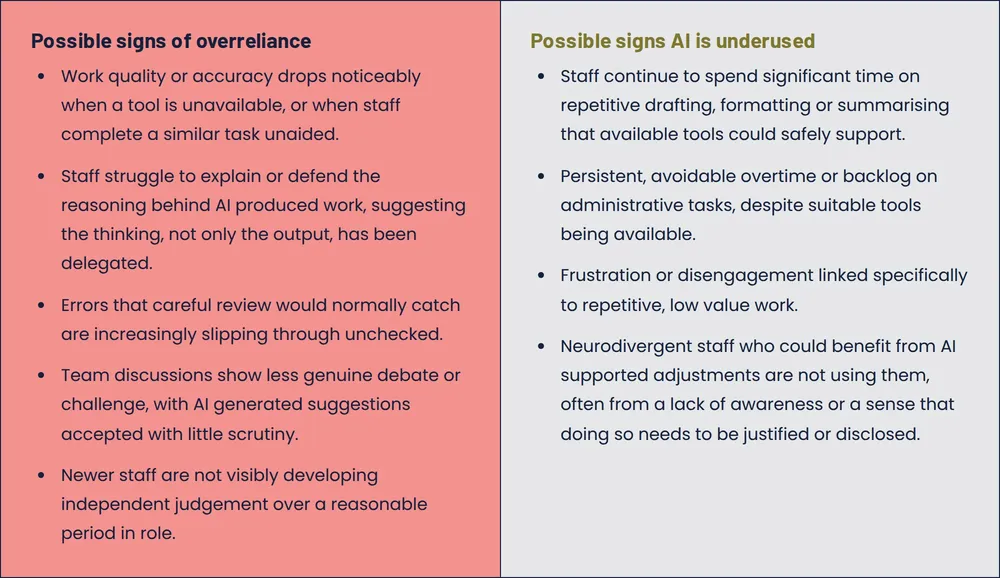
A useful practice is to treat both columns as prompts for a conversation with the individual or team, rather than as a checklist to be judged against silently. The aim is intentional calibration, not a fixed rule about how much AI use is correct or acceptable.
CONSIDERATIONS FOR NEURODIVERGENT EMPLOYEES
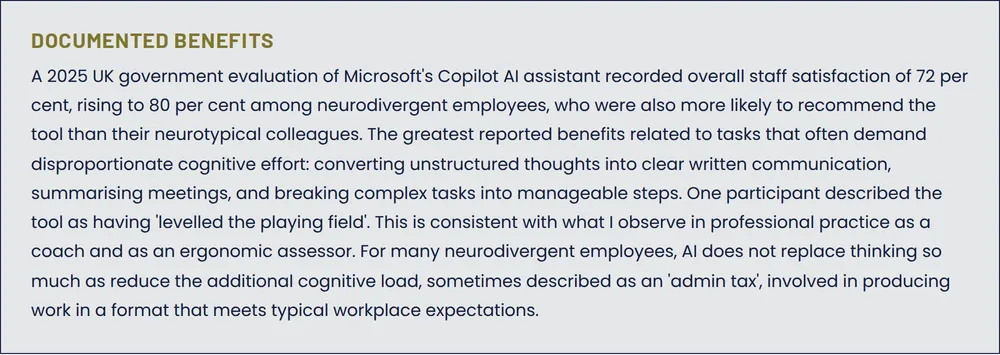
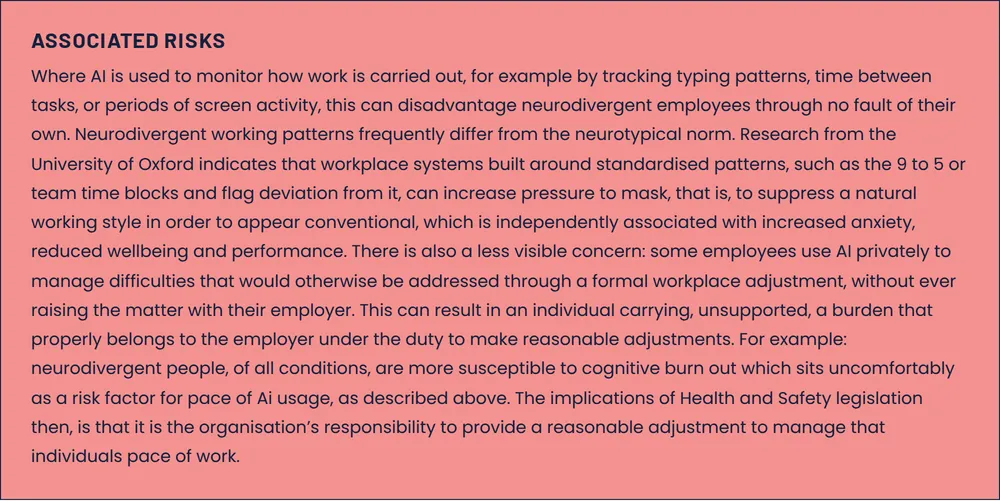
Approximately one in seven people in the UK are neurodivergent, an estimate originating with the NHS and now widely repeated by local authorities and charities and includes those who are autistic, have ADHD, dyslexia or dyspraxia, OCD, menopause and some mental health conditions or a combination of these. The figure is not drawn from a single headcount but aggregated from the separate prevalence rates of individual conditions, so estimates elsewhere range from one in seven to one in five depending on methodology and diagnosis rates. One in seven remains the most commonly cited, and most conservative, end of that range. For this group, the picture of Ai impact is considerably more nuanced, and includes both genuine benefit and genuine risk. Both deserve to be stated clearly and understood in the workplace context.
REASONABLE ADJUSTMENTS INVOLVING AI
Under the Equality Act 2010, employers have a legal duty to make reasonable adjustments for employees whose impairment places them at a substantial disadvantage at work. Many neurodivergent conditions meet this threshold, and Acas guidance is explicit that a formal diagnosis is not required before support is offered. AI now has a genuine, practical role on both sides of this duty.
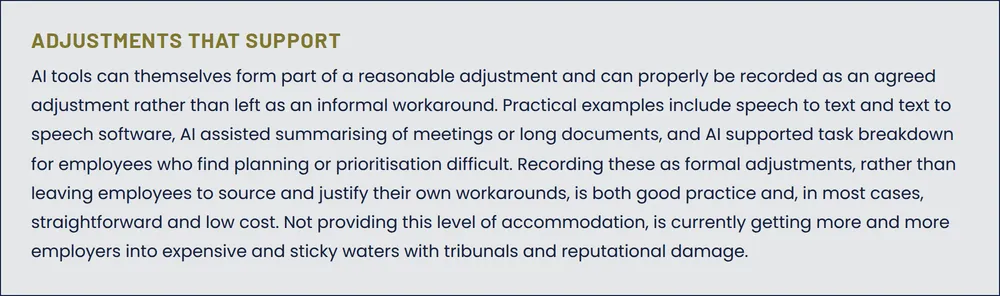
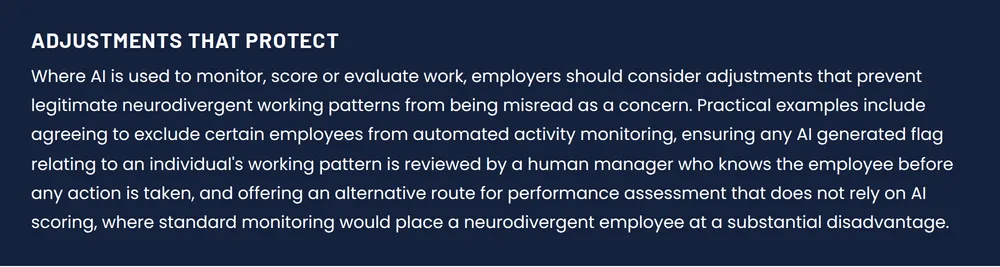
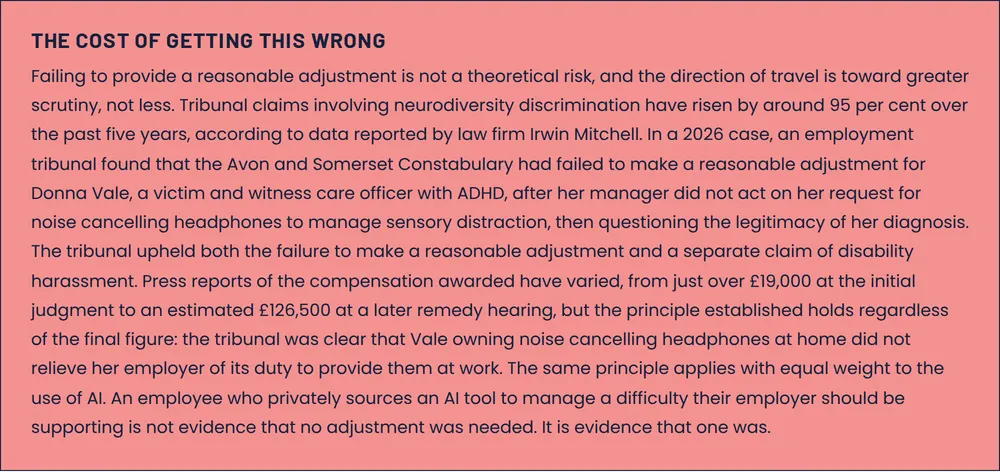
As with any reasonable adjustments, the right approach depends on the individual rather than the diagnosis and should be agreed through direct conversation with the employee concerned. Ideally, reasonable adjustments should be informed by external and impartial occupational health input or a workplace needs assessment. Recent guidance from HSE heavily emphasised that the implementation of reasonable adjustments should be led by the organisation, not the employee, and that adjustments should be expedited and followed through to full integration, not left to fall off the radar. In this sense, good practice would be to follow implementation of reasonable adjustments rather like a project. Ironically, Ai might be a very useful tool in managing implementation of reasonable adjustments for busy HR departments and managers.
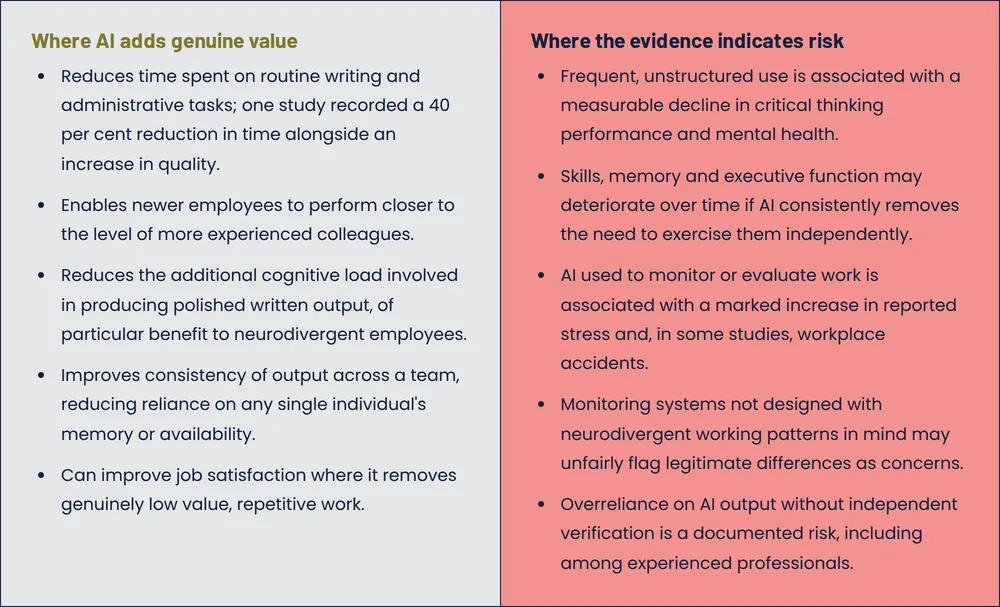
BENEFITS AND RISKS AT A GLANCE
Below I offer a balanced comparison of the possible benefits and risks of Ai usage, since treating this as uniformly positive or uniformly negative serves nobody making actual strategic decisions.
UK LAW AND HEALTH AND SAFETY OBLIGATIONS
UK law does not currently contain legislation specific to AI in the workplace. Instead, a number of existing legal duties apply to AI in the same way they apply to any other workplace practice or technology.
Health and Safety at Work etc. Act 1974
Places a general duty on employers to ensure, so far as is reasonably practicable, the health, safety and welfare of employees. This duty extends to psychological harm as well as physical harm, and therefore covers stress or anxiety arising from how AI tools are introduced or used, including AI based monitoring.
Management of Health and Safety at Work Regulations 1999
Requires employers to carry out a suitable and sufficient risk assessment of anything that could cause harm, including new technology such as AI. Where AI materially changes how a role is carried out, this duty is likely to apply.
UK GDPR and the Data Protection Act 2018
Govern how employee data, including data generated or used by AI tools, may be processed. Monitoring must be lawful, necessary, proportionate and transparent, in line with the Information Commissioner’s Office guidance on monitoring workers, published in 2023. A Data Protection Impact Assessment is generally required before introducing monitoring technology that poses a high risk to employees’ rights.
Automated decision making provisions within UK GDPR
Give employees certain rights where a decision with a significant effect on them, such as one affecting pay, a performance rating or continued employment, is made solely by an automated system, without meaningful human involvement.
Equality Act 2010
Requires employers to make reasonable adjustments for disabled employees, a category that includes many neurodivergent employees, and this duty applies fully to AI systems used in the workplace, as set out in the section above.
In practical terms, the legislative responsibility means employers should treat the introduction of any AI tool that materially changes how work is carried out, monitored, allocated or assessed with the same rigour as any other significant workplace change, including staff consultation, a documented risk assessment, and, where personal data is involved, a data protection assessment.
DOES THIS AFFECT SMALLER BUSINESSES DIFFERENTLY
Inspired Ergonomics is an SME and as COO, I spend a lot of time researching operational efficiencies and tools to leverage for the business. We use Ai and will be undertaking ISO 42001 certification in the near future, so I have conducted thorough, if slightly hyperfocussy, examination of Ai on SME businesses. There is evidence that AI’s impact differs by organisation size, though not in a single, straightforward direction.
Adoption itself seems to remain slower among smaller firms, according to research published by Microsoft and the policy consultancy WPI Strategy. Fewer than one in five UK small and medium sized enterprises had adopted AI as of 2025, and their research attributes this primarily to a lack of in-house expertise, cost and uncertain return on investment, rather than to a lack of interest.
However, once smaller firms do adopt AI, usage tends to be more intensive. Government research found that a larger proportion of staff use AI regularly in micro and small firms than in large organisations, where adoption is broader overall but usage per employee is often lighter and more closely governed. It is a bit like giving a large ship and a small dinghy the same size engine. The large ship has the crew, training and instruments to handle the extra power safely. The dinghy simply goes faster toward whatever happens to be in front of it.
This has a specific implication for the concerns raised throughout this analysis. Larger organisations are more likely to have dedicated human resources, occupational health, data protection functions and governance systems capable of assessing AI tools for the risks described before they are introduced. Smaller firms, and particularly micro businesses, frequently do not have this infrastructure, meaning individual employees may end up using AI more heavily, with fewer safeguards and less oversight, than their counterparts in larger organisations. The risk for smaller businesses is therefore less about the scale of AI use, and more about the absence of structured governance around it. This is a genuine consideration for SME leaders without a dedicated HR or health and safety function, who may need to seek external advice to meet the obligations still required of them by UK legislation. Add to that, the cost and impact of reduction in staff wellbeing and performance, for any reason, governance of factors that affect those factors should be considered a fundamental business need.
GUIDANCE FOR EMPLOYERS
The good news is that it is not necessary to design a new framework for this purpose. The Health and Safety Executive, the UK’s workplace safety regulator, already provides a well-established and freely available approach to managing work related stress, structured around six factors: the demands placed on employees, the degree of control they have over their work, the support available to them, the quality of workplace relationships, clarity of role, and how change is managed. AI affects each of these areas, and any effective AI deployment should be considered against this framework before implementation, alongside the specific legal duties set out above.
- Consult employees before deployment, not after
Organisations that involve staff in decisions to introduce AI report better outcomes for both productivity and wellbeing than those that do not. This is one of the more consistent findings in the research and should inform implementation planning from the outset.
- Distinguish assistive tools from monitoring tools
A tool that helps an employee draft correspondence represents a materially different category of risk from a system that scores, monitors or flags an individual’s work. The latter carries substantially greater risk and should be governed accordingly. Employers should be transparent with staff about which category of tool is being introduced.
- Preserve opportunities for unassisted practice
For tasks requiring independent judgement, particularly where safety or professional standards are involved, employers should build in regular opportunities for staff to complete work without AI assistance, in order to maintain proficiency rather than allow it to decline unnoticed.
- Assess monitoring tools for bias against neurodivergent working patterns
Any AI system used to monitor or evaluate performance should be assessed for bias against atypical, but entirely legitimate, working patterns and performance before it is applied to any neurodivergent or disabled employee, and the adjustment examples set out above should be considered as standard practice, not an exception.
- Review outcomes several months after implementation
A structured review, focused on employee experience rather than output metrics alone, should be conducted some months after deployment, using the manager indicators set out earlier in this guide to identify and address emerging concerns while they remain manageable. Well managed change projects include outcome reviews, lessons learned and operational transition as best practice. Organisations can make use of well known change management models to deploy Ai successfully into workplaces.
GUIDANCE FOR INDIVIDUALS
- Attempt tasks independently before using AI
Evidence suggests that even a brief, unaided attempt before introducing AI assistance improves retention of skill and understanding, compared with using AI as the first step.
- Use AI to challenge your thinking, not only to produce answers
Prompting AI to ask questions or identify weaknesses in an argument, rather than simply generating a finished response, has been shown to support stronger critical thinking than passive use.
- Protect recovery time between fast paced tasks
If AI allows you to complete tasks more quickly, use at least some of that time to properly step away, rather than filling it immediately with further tasks. This directly addresses the pace and attention concern discussed above.
- Notice where your confidence is placed
If you find yourself trusting AI output more readily than your own judgement, it is worth considering why. This is often where errors go unchecked.
- If you are neurodivergent and using AI to manage difficulties informally, consider raising this with your employer
Using AI in this way is entirely valid. It is also worth recognising that where it is compensating for something a formal adjustment would otherwise address, you are entitled to request that support directly, rather than managing it independently on an ongoing basis.
Further information and support
| HSE, Working Minds and the Stress Indicator Tool The free UK framework referenced above. |
| Information Commissioner’s Office, guidance on monitoring workers The current UK regulatory position on AI based monitoring. |
| ACAS Free, impartial guidance on employment rights, adjustments and workplace change. |
| National Autistic Society Practical, UK specific guidance on workplace adjustments and disclosure. |
| ADHD Foundation Practical, UK specific guidance on workplace adjustments and disclosure. |
| Mind A suitable first point of contact if any of the above is affecting your day to day wellbeing. |
IN SUMMARY
This research was enlightening for me, personally and professionally, but it also challenged a bias I noticed myself increasingly adopting: that AI is a health risk that needs managed. As with most assumptions, I think I had it the wrong way round. Humans are still the risk that requires managing, not the technology.
AI at work is neither straightforwardly good news nor bad news for those concerned with health, safety and human performance. It represents a set of trade-offs, and those trade-offs land differently depending on who is affected, the size and resources of the organisation, and how the tool is used. Used thoughtfully, and within the protective legal frameworks that already exist in the UK, it can return time, energy and confidence to employees, particularly those who have long carried an additional, often invisible, cognitive load. Used carelessly, irresponsibly, or deployed primarily to monitor rather than support staff, it can dull the very judgement it was intended to assist, and the effect tends to land hardest on those least able to absorb it.
None of what I found calls for alarm rather it calls for the same discipline, integrity and compassionate leadership that good workplace practice and design has always required: attention focused on the person or people doing the work, not only the tool or system placed alongside them.
If I could liken this to another IT powerhouse that every organisation, in every country, all over the world will recognise, it is this: Microsoft Excel. Just because you provide it, and it is globally recognised, does not mean your people know how to use it optimally. Some will be Excel wizards who could rule the world through spreadsheets and formulas alone. Others would sell their granny’s pet rather than admit they do not know how to use it. What makes the difference is strategic operational direction, quality training and guidance, open minded leadership, and a culture that encourages people to ask for help. Same with AI.
If your organisation is introducing AI and would value support in doing so without compromising staff wellbeing, judgement or inclusion, we would be glad to discuss this further.
Contact info@isnpiredergonomics.com

Nichola Adams
Nichola is a specialist in back pain disorders in the workplace. Inspired Ergonomics regularly provides consultancy services to leading UK and International companies on how to reduce and prevent back pain in the workplace as well as working with rehabilitation companies.