
by Joanne Allpress – Senior Ergonomics Consultant
If you’ve ever looked into ergonomics or musculoskeletal health, you’ve probably come across the phrase:
“The best posture is the next posture.”
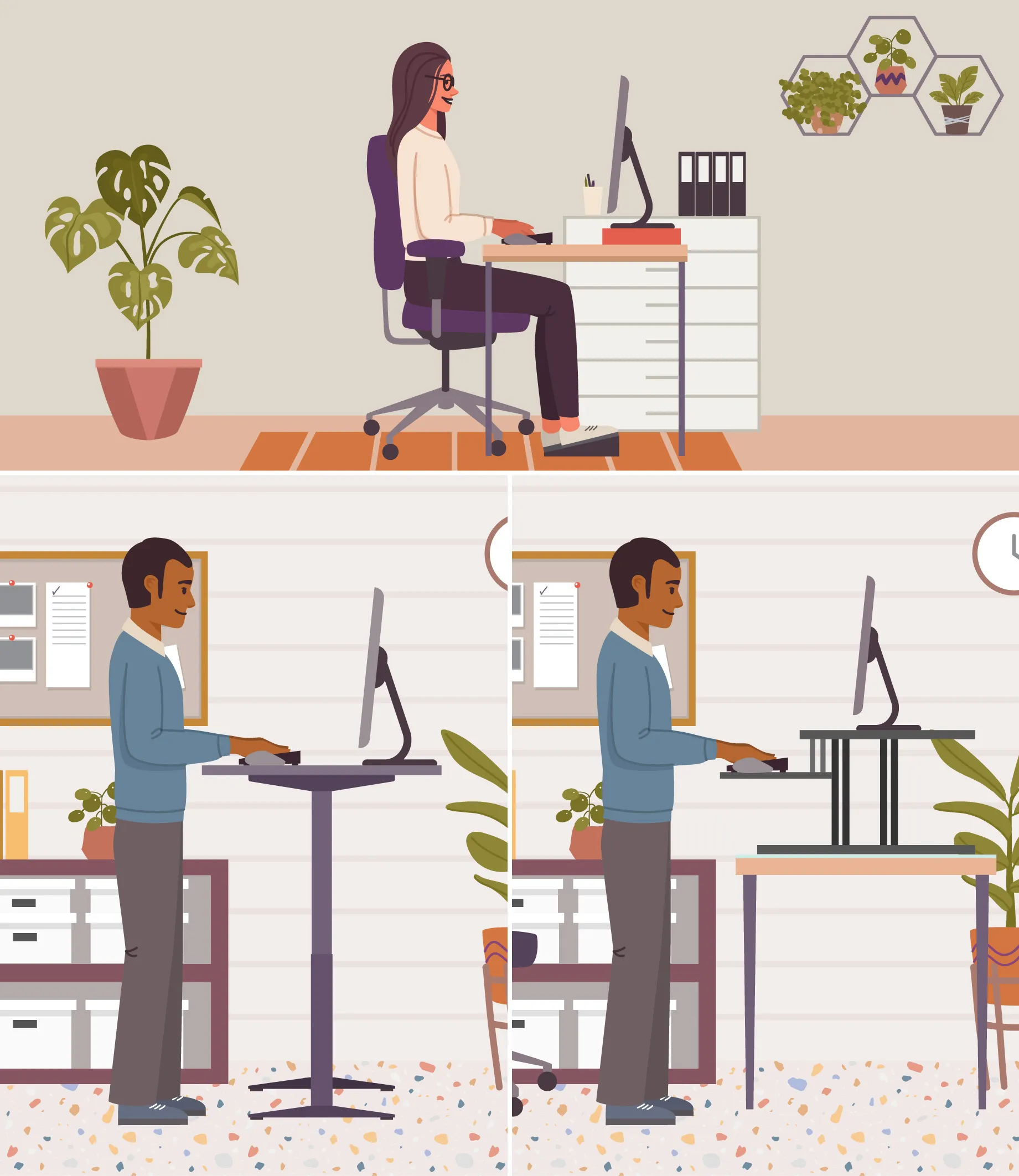
It’s a message that has become increasingly popular, particularly amongst healthcare professionals specialising in musculoskeletal health, and for good reason. The idea is simple: our bodies are designed to move, and staying in one position for prolonged periods is often more problematic than changing position regularly.
As an ergonomist, I agree with this… to a point.
Why has this phrase become so popular?
Historically, DSE assessments focused heavily on achieving the “perfect” sitting posture. Chairs were adjusted, monitor distances were measured in comparison to arm lengths, and employees were encouraged to maintain an ideal position throughout the day.
We now know that there isn’t one perfect posture that can be comfortably maintained for eight hours. Even a textbook workstation setup will become uncomfortable if the user remains static for too long.
Research has consistently shown that prolonged static loading of muscles contributes to discomfort and fatigue. Regular movement improves circulation, redistributes pressure, varies muscle activity and gives tissues an opportunity to recover.
So far, so good.
Where the phrase can become misleading
The challenge comes when the phrase is interpreted as:
“I can move frequently from one bad posture to another.”
During DSE assessments, it’s common to see people naturally “move” throughout the day, but often into progressively poorer postures.
Perhaps they begin the morning sitting their chair with their back fully supported.
An hour later they’re leaning forwards.
Then they’re perched on the edge of the chair.
By mid-afternoon they’ve slumped down through the chair with arms extended over the desk to use a keyboard and mouse that are positioned too far away.
Yes, they’ve changed posture.
But the new posture may place greater demand on muscles, joints or soft tissues than the previous one.
What do the principles of ergonomics aim to achieve?
The principles of ergonomics are to fit the work to the individual by reducing unnecessary physical and cognitive demands, encouraging neutral working postures, facilitating movement and variation, and designing work that is safe, comfortable and efficient.
Rather than encouraging people to continually drift between awkward postures, we generally encourage:
- Working from a neutral posture
- Moving frequently
- Returning to a neutral posture after changing position
- Varying tasks alongside varying posture
Think of a neutral posture as your “home base”.
There’s absolutely nothing wrong with leaning forwards to read something closely, turning to collaborate with a colleague or reclining for a period.
The important part is that these become temporary working positions rather than permanent ones.
What does the evidence suggest?
Interestingly, the research doesn’t really support either extreme of the debate.
Studies of occupational biomechanics have consistently shown that prolonged static postures are associated with increased musculoskeletal discomfort, regardless of whether the posture is considered “good” or “bad”. Remaining still for extended periods can contribute to muscle fatigue and reduced blood flow, even when sitting in a relatively neutral position.
Equally, the evidence shows that prolonged awkward or non-neutral postures, such as sustained neck flexion, elevated shoulders, extended reaches or excessive wrist deviation, place greater mechanical loading on muscles, tendons and joints, increasing the risk of musculoskeletal disorders over time.
This is why standards such as ISO 11226 (Evaluation of Static Working Postures) and guidance from the Chartered Institute of Ergonomics & Human Factors (CIEHF) don’t advocate choosing between movement or posture. Instead, they promote avoiding prolonged static postures whilst also minimising time spent in awkward postures.
In practice, this means that:
- Movement is beneficial.
- Neutral working postures reduce unnecessary physical loading.
- The greatest benefit comes from moving regularly between comfortable, well-supported postures, rather than remaining static or repeatedly adopting awkward ones.
Perhaps, then, “the best posture is the next one” is only part of the story. Movement is undoubtedly important, but ergonomics encourages movement within good ergonomic principles, such as moving regularly while returning to a comfortable, neutral working posture that minimises unnecessary physical loading.
So, should we stop saying “the best posture is the next posture”?
Probably not.
It’s a memorable phrase that encourages people to move more, and that’s a positive message.
However, perhaps a more complete version would be:
“The best posture is the next posture… provided you regularly return to a comfortable, well-supported, neutral working position.”
That might not fit so neatly on a poster, but it probably reflects the evidence a little more closely.
The takeaway
Movement matters.
Neutral posture matters.
Neither should be considered in isolation.
The goal isn’t to sit perfectly all day, nor is it simply to keep moving regardless of posture. The goal is to create a working pattern where movement is frequent, posture is varied, and the body regularly returns to a position that minimises unnecessary physical loading.
After all, good ergonomics isn’t about finding the perfect posture, it’s about finding a sustainable way of working that is correct for the individual’s biomechanics (and any injuries or long-term conditions), anthropometrics, preferred behavioural patterns and psychological influencing factors affecting these.

Nichola Adams
Nichola is a specialist in back pain disorders in the workplace. Inspired Ergonomics regularly provides consultancy services to leading UK and International companies on how to reduce and prevent back pain in the workplace as well as working with rehabilitation companies.